



Blog
The Ultimate Solar Street Light Battery Guide

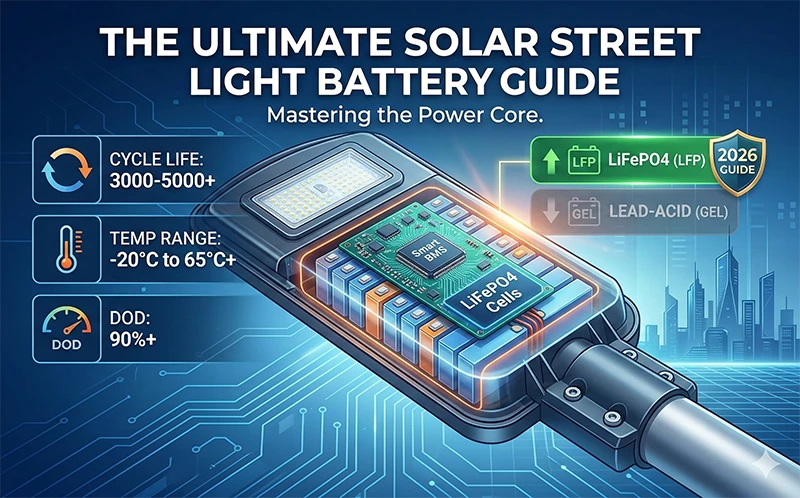
Solar street lights have revolutionized outdoor illumination, offering a sustainable, grid-independent solution for cities, highways, and remote communities. While the photovoltaic panel captures the headlines, the true heart of any reliable solar lighting system is hidden within its base or pole: the battery.
As we navigate through 2026, the technology powering these systems has matured significantly. The battery is no longer just a passive reservoir; it is a complex component that dictates the system’s lifespan, reliability during successive cloudy days, and overall total cost of ownership (TCO). This guide provides a comprehensive technical overview of solar street light battery types, designed for engineers, project managers, and sustainability officers.
1. The Critical Role: More Than Just Storage
In a solar street light system, the battery executes a complex, high-stakes ballet every 24 hours. Its primary function is energy time-shifting—storing the volatile, variable energy generated by the PV panel during daylight and releasing it as stable, regulated power to the LED driver at night.
However, the battery’s engineering role extends beyond simple storage. It must act as a massive buffer, regulating voltage fluctuations coming from the solar charge controller. A high-quality battery ensures that the LED driver receives constant current, maximizing the life of the LEDs themselves. Furthermore, the battery must be resilient. Unlike a stationary home storage system, street light batteries face high ambient temperatures (especially in the Philippines or Middle East) and deep daily discharge cycles. A failure here is a public safety failure.
Caption: Schematic detailing the critical energy buffering role of the battery pack, highlighting how it must simultaneously interface with variable solar input (Day Cycle) and stable lighting output (Night Cycle) while regulated by the Charge Controller.
2. Navigating Battery Chemistries: The Triumph of Lithium
The landscape of solar lighting batteries has shifted dramatically. In 2026, the discussion is no longer about whether to use lead-acid, but which Lithium chemistry is appropriate for the environment.
Historically, Lead-Acid (AGM or Gel) batteries dominated due to their low upfront cost. However, they suffer from heavy weight, a shallow Depth of Discharge (DOD—typically 50%), and severe performance degradation in high temperatures. They rarely last more than 2-3 years in standard street light applications, leading to high maintenance costs and environmental disposal issues.
Lithium technologies have rendered lead-acid obsolete for high-reliability projects. Lithium-ion (Li-ion), particularly Nickel Manganese Cobalt (NMC), offers high energy density (more power in a smaller, lighter package) and a deeper DOD (up to 80-90%).
However, the reigning champion in 2026 for solar street lighting is Lithium Iron Phosphate (LiFePO4). While slightly less energy-dense than NMC, LiFePO4 offers unparalleled thermal stability (it is much safer and less prone to “thermal runaway” in extreme heat), a significantly longer cycle life (2,000 to 5,000+ deep cycles compared to NMC’s 800-1,500), and maintains its capacity much better across varying temperatures. For robust infrastructure, LiFePO4 is the engineering standard.
| Technical Metric | Lead-Acid (Gel/AGM) | Li-ion (NMC) | LiFePO4 (LFP) |
| Cycle Life (@80% DOD) | 300 – 500 Cycles | 800 – 1,500 Cycles | 3,000 – 5,000+ Cycles |
| Operating Temp Range | -10°C to 45°C | -20°C to 55°C | -20°C to 65°C+ |
| Depth of Discharge (DOD) | Recommended 50% | 80% – 90% | 90% – 100% |
| Energy Density | Very Low (Heavy) | Very High (Light) | High (Moderate) |
| Safety / Thermal Stability | Moderate | Low (Risk of fire) | Highest (Non-combustible) |
| Environmental Impact | Low (Contains Lead) | Moderate | High (Non-toxic/Green) |
| Initial Upfront Cost | 💰 Lowest | 💰💰 Medium | 💰💰💰 Highest |
| Long-term ROI | 🔴 Poor (2-year replacement) | 🟡 Average | 🟢 Superior (10-year life) |
Caption: A technical infographic comparing the performance metrics of Lead-Acid, NMC, and LiFePO4 batteries in 2026. LiFePO4 columns dominate in Cycle Life, Operational Temperature Range, and Depth of Discharge, making it the preferred engineering solution.
3. Key Performance Metrics: DOD, Cycle Life, and Capacity
When evaluating a solar street light battery datasheet, specific metrics determine the system’s engineered lifespan.
Depth of Discharge (DOD)
DOD refers to the percentage of the battery’s total capacity that is used during a discharge cycle. If a battery has a 100Ah capacity and you use 80Ah, the DOD is 80%. As mentioned, Lead-Acid is limited to 50% DOD to prevent instant failure. In contrast, modern LiFePO4 systems are commonly engineered to operate at 80% or even 90% DOD daily. This depth allows for smaller, lighter battery packs that deliver the same usable energy as much larger lead-acid equivalents.
Cycle Life vs. DOD
The most critical relationship on any datasheet is Cycle Life at a specific DOD. All batteries degrade over time, but the rate of degradation is linked directly to how deeply they are cycled. A LiFePO4 battery might offer 5,000 cycles at 50% DOD, 3,000 cycles at 80% DOD, and perhaps 2,000 cycles at 100% DOD. Engineers must prioritize a battery that meets the required lifespan (e.g., 10 years or 3,650 daily cycles) at the system’s designed daily DOD. In robust designs, the daily DOD is often capped at 70-80% to maximize lifespan.
Rated Capacity (Ah/Wh)
Total battery capacity is measured in Amp-hours (Ah) or, more accurately, Watt-hours (Wh). Watt-hours ($\text{Voltage} \times \text{Amp-hours}$) provides the total energy reservoir. For solar street lights, the capacity must be sized not just for one night, but to provide “Autonomy”—the number of consecutive rainy or cloudy days the system can operate without solar input. A standard configuration in Southeast Asia might require 3 days of autonomy, meaning the battery must hold enough energy to power the light for three full nights while discharging only to its safe DOD.
Caption: An engineering graph illustrating the profound impact of Depth of Discharge (DOD) on LiFePO4 battery Cycle Life (in thousands), showing how cycle life drops significantly as DOD increases, with high temperatures further reducing life.
4. Intelligent Management: The Battery Management System (BMS)
A solar street light battery in 2026 is never an “isolated cell.” It must operate as an intelligent subsystem overseen by a integrated Battery Management System (BMS). The BMS is the unsung hero, ensuring safe operation and maximizing cell lifespan.
The Role of the BMS
A dedicated BMS manages a string of lithium cells by:
-
Cell Balancing: Correcting voltage imbalances between individual cells in the battery pack, preventing overcharge or over-discharge of single cells while others are still active.
-
Overcharge/Over-discharge Protection: Preventing the battery from accepting charging current once it is full or discharging below its safe DOD.
-
Temperature Monitoring: Measuring cell temperature. In 2026, premium LiFePO4 batteries include internal heating elements powered by the solar panel to safely charge at temperatures below freezing, while shutting down when temperatures exceed safety thresholds ($>60^{\circ}\text{C}$).
-
Short-Circuit and Over-current Protection: Immediately disconnecting the pack if an electrical fault is detected.
MPPT Charge Controllers and Battery Sync
For optimal health, the MPPT (Maximum Power Point Tracking) charge controller must communicate seamlessly with the BMS. Modern MPPTs are synchronized with the battery pack to dynamically adjust charging algorithms based on cell health data, temperature, and historical performance, a process often guided by IoT connectivity (see 2026 perspective).
Caption: An integrated block diagram for a BMS within a 2026 solar battery pack, labeling functions such as ‘Individual cell balancing’, ‘Current Sensing’, ‘Temp Sensor Array’, and ‘Communication Interface’.
5. Summary: Engineering for the Decade
In 2026, the battery is no longer a weak link in solar street light design; it is the enabler of reliable, long-term infrastructure. For high-performance projects, the engineering mandate is clear: Prioritize Lithium Iron Phosphate (LiFePO4).
Ensure the battery capacity is sized with adequate “Autonomy” (typically 3 days) to handle cloudy weather without exceeding safe DOD levels. Insist on a integrated, robust Battery Management System (BMS) with cell balancing and thermal management. Finally, review all performance data (DOD and Cycle Life relationship) in the context of the project’s required total lifespan (e.g., 10 years). Following these rigorous technical guidelines will guarantee a lighting system that truly provides sustainable public safety.