



Blog
Solar Street Light for Philippines

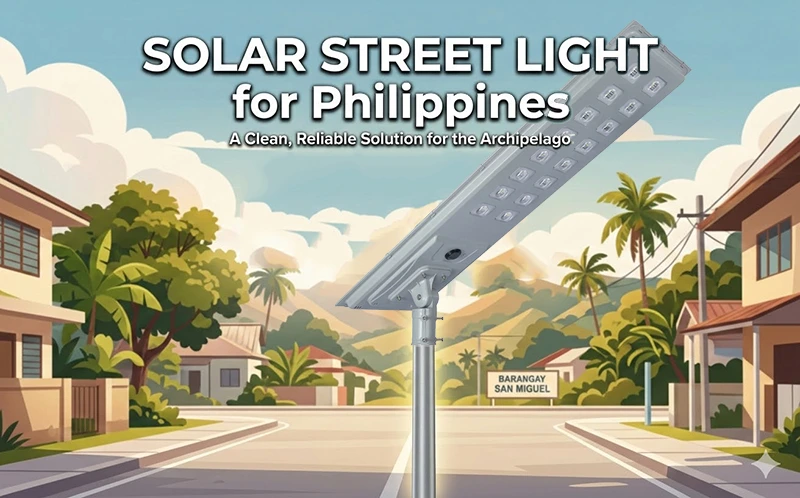
Solar Street Lights has evolved from a “green trend” into a fundamental necessity for national infrastructure.
For decades, the Philippines has grappled with some of the highest electricity prices in Southeast Asia. This economic burden, coupled with an aging power grid that often falters during “brownout season,” has made traditional street lighting a massive liability for both Local Government Units (LGUs) and private developers.
Harnessing Tropical Irradiance
The Philippines enjoys an average daily solar radiation of about $4.5$ to $5.5 kWh/m^2$. In layman’s terms: we have a goldmine of energy falling on our heads every day. Solar street lights capitalize on this by being entirely self-sufficient. By decoupling public lighting from the main grid, municipalities can effectively “delete” a significant portion of their monthly utility bills.
Resilience in the Face of Disaster
When a typhoon hits, the first thing to go is usually the power lines. Traditional street lights become useless poles of metal in the dark. Solar street lights, however, operate as independent units. As long as the pole stands, the light stays on. This is critical for emergency response, allowing rescue teams and residents to navigate flooded or debris-strewn streets safely after the storm has passed.
Environmental Stewardship
As part of the Philippines’ commitment to the Paris Agreement and the push for Sustainable Development Goals (SDGs), transitioning to LED solar lighting significantly reduces the carbon footprint of urban centers. It’s a clean, silent, and non-intrusive way to modernize the landscape without adding strain to the country’s limited coal and gas-fired power plants.
2. Technical Resilience: Engineering for Typhoons and Salt Air
Not all solar lights are created equal, especially in the Philippine context. A light designed for the mild climate of Europe will likely fail within six months in the humidity of Cebu or the salty air of Batanes. To succeed here, the hardware must be “Filipino-proof.”
The Battery Battle: LiFePO4 is King
In 2026, the industry has moved decisively away from old-school Lead-Acid and standard Lithium-ion batteries. The gold standard for the Philippines is Lithium Iron Phosphate (LiFePO4). Why? Because they can withstand the high ambient temperatures of the tropics without degrading rapidly. They offer over 2,000 charge cycles, meaning a well-maintained light can easily last 5 to 8 years before needing a battery swap.
IP Ratings and Material Integrity
The “IP” (Ingress Protection) rating is the most important spec on the datasheet. For a country that experiences horizontal rain during monsoon season, an IP65 or IP67 rating is non-negotiable. This ensures that neither torrential rain nor fine dust can penetrate the casing. Furthermore, for coastal installations, high-quality aluminum alloy or specialized anti-corrosion coatings are essential to prevent the “rust-out” effect caused by saline sea breezes.
Smart Controllers and Dimming Profiles
Modern solar lights in the Philippines now utilize MPPT (Maximum Power Point Tracking) controllers. These “brains” of the unit are much more efficient at harvesting energy on cloudy, overcast days—a common occurrence during the long rainy season. Additionally, smart dimming (using motion sensors or pre-set timers) ensures that the battery isn’t wasted at 2:00 AM when the streets are empty, preserving energy for the pre-dawn hours when people are heading to work.
3. The Socio-Economic Impact: Beyond Just “Lighting the Way”
The installation of solar street lights does more than just illuminate the pavement; it transforms the socio-economic fabric of Filipino communities.
Boosting the “Barangay Economy”
In rural areas, life often used to stop when the sun went down. With the arrival of reliable solar lighting, sari-sari stores can stay open later, children can study under the glow of a street lamp if their homes lack adequate power, and community gatherings can extend into the evening. It fosters a 24-hour micro-economy that was previously impossible in off-grid locations.
Enhancing Public Safety
Crime thrives in the dark. LGUs across the country have reported significant drops in petty crime and road accidents following the installation of solar lighting in formerly “blackout-prone” zones. For women and workers coming home late from BPO shifts, a well-lit street provides a psychological and physical sense of security that is invaluable.
Ease of Installation and Maintenance
One of the biggest hurdles for traditional infrastructure is the “digging.” Laying underground cables for miles is expensive and disruptive. Solar street lights require no trenching. You dig a hole, set the pole, and you’re done. This “plug-and-play” nature allows for rapid deployment in remote islands where bringing in heavy cable-laying equipment would be logistically impossible.
1. Will these lights actually stay on during the rainy season when there’s no sun for days?
3-5 days of autonomy
But in most cases in rural road, 12-18 hours lighting enough. With automatic light management, the light will turn down or off after midnight or few people go through. 12-18 hours means several nights
2. How do we prevent people from stealing the batteries or the entire unit?
All-in-One (AIO) or All-in-Two
3. Why do some solar lights fail after only 6 to 12 months?
This is usually due to “Bottom-Tier” components. Many cheap units flooding the market use “B-grade” battery cells or repurposed laptop batteries that can’t handle the Philippine heat. Another culprit is poor heat dissipation; if the LED chips get too hot, they burn out. Always look for brands that offer a 3-to-5-year warranty and have a local service center.
4. The upfront cost is so high. How is this better than traditional Meralco-powered lights?
Return on Investment (ROI)
5. Do I need to clean the panels? What about the dust and bird droppings?
Yes, maintenance is the “silent killer” of solar efficiency. In the Philippines, dust buildup during the dry season and bird droppings can reduce power harvest by 20-30%. A simple annual cleaning with water and a soft brush is usually enough. Some high-end industrial models in 2026 even come with self-cleaning mechanisms or tilted designs that allow rain to wash away debris naturally.